
October - Strength Through Connection
Co-regulation With the Human & More-Than-Human World

Hello Readers,
Before we go any further, I’d like to do a simple sensory exercise with you:
Look around you and identify three different colors that you can see. Mine are red, brown, and green.
Soften your gaze or close your eyes and notice two different sounds you can hear. I can hear my dog softly snoring and the noise of my neighbors talking outside.
Feel the tactile sensation of something you can touch—like the ground you’re standing on, the chair you’re sitting on, or a wall next you. I can feel the soft cushions of the couch underneath me.
Take a deep breath and notice the smells in the air around you. I smell the onions that I recently cooked.
Now, having connected to your external senses around you - start to notice your body. Where are your arms and legs in space? My legs are currently crossed with my computer on my lap, my hands typing on the keyboard.
Take a few seconds and gently stretch your neck or roll out your shoulders. Open and close your mouth a few times to stretch your jaw.
Finally, bring your attention inward and feel your breath moving in and out of your lungs for a couple breath cycles. Notice the rise and fall of your belly and/or chest. Feel the sensation of air moving through your nose and throat.
What did you notice? What did you feel?
This exercise is based off of a technique from a couple different modalities that serve to ground and connect one’s awareness. It’s useful in starting to re-set the nervous system if you find yourself in an anxious state. It’s also one of the first exercises in Ecotherapy practice used to encourage participants to slow down and connect with their surroundings.
I completed my Level 1 Ecotherapy certificate in 2022 as part of my master’s degree capstone project, building a business plan to incorporate Ecotherapy in Palliative Care as an end-of-life doula, which you can read more about below:
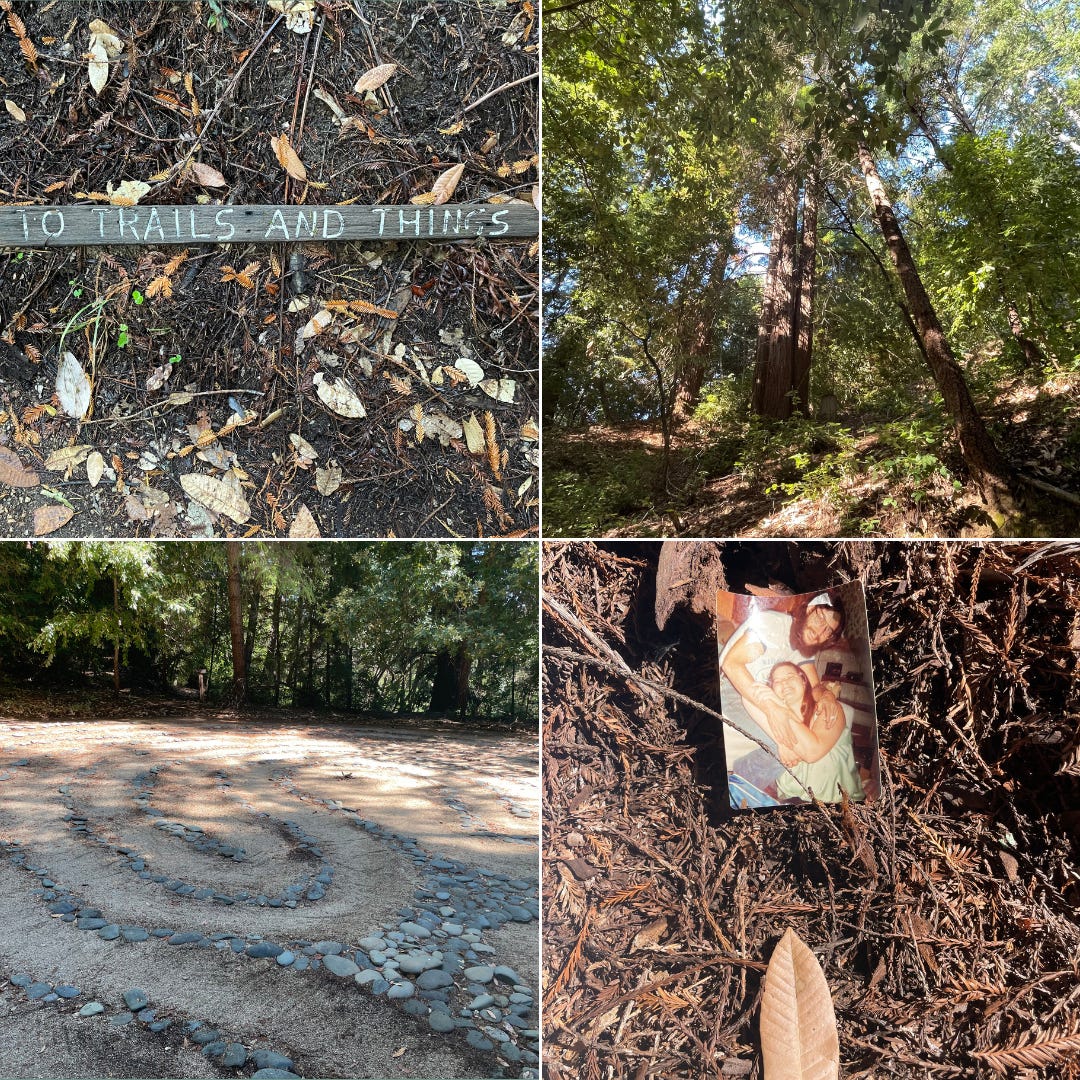
At the end of September this year I was able to complete my Level 2 certificate during a 5-day in-person immersion training just outside of Santa Cruz, CA. It was an incredibly profound experience for a multitude of reasons. I gained so many new skills, experienced a level nourishment and nervous system regulation I didn’t know I needed, and made profound connections with humans and non-humans (the deer, the redwoods, the oak, the spiders, just to name a few). In many ways it felt like a dream: waking up in a tree house every morning with my fellow participants, wandering down a path to the main lodge for breakfast, and spending our days exploring and healing the relationship between the human psyche and nature while safely nestled in the redwood groves. Some time was spent in other environments among the old-growth oak trees, eucalyptus, and of course some time on the beach.
Most significantly, it was my first visit to Santa Cruz—but it’s also where my dad was born. My dad’s death in 2021 was a significant factor in my decision to do the work I offer now. Visiting the part of the world where he was born was like coming home to a place I’ve never been. There is a soul-level connection between us and the land where we are born, where our parents were born, and where our ancestors were born. Living in the same city where I was born, I’ve never felt that connection so palpably. I received permission to bury some of my dad’s ashes under a redwood tree on the property and have such deep appreciation for the strength of the connection I still feel to that place and the reminder that life and death are not separate. Death is part of nature and part of the natural life cycle.
When I think about my home in Colorado, it’s challenging to not notice how the “outdoors” cultural emphasis here is much more focused on outdoor sports and activities that perpetuate a need to “survive” or “conquer” the outdoors rather than being in reciprocal relationship with nature. Even for myself. I love hiking and backpacking, and even completed a segment of the Colorado Trail on a solo trip this summer. However, when approaching the outdoors with an attitude of trying to get to the top of the mountain as fast as possible, or seeing how many 14-ers you can hike in one day—I can’t help but feel like there’s a lost opportunity. First of all, it limits access to nature and the outdoors to those with privilege and physical ability. Second, it reinforces the human, industrial mindset that disconnected us from the natural world around us to begin with.
Slow down. Use all of your senses to fully experience the world around you. Do more than just look at the trees. Listen to the birds. Touch the grass (literally, put your hands on the ground). Smell the pine trees. Feel the trees swaying with the wind—sway with them. Nothing in nature lives in isolation. The tallest redwood trees are supported by the root systems of the surrounding trees. The stumps of felled trees become incubators for other species. Put your back against a tree and remember how it feels to touch the earth and the sky at the same time, so that when you walk away—you stand taller, with your head higher. We have the extreme privilege and task of living on this planet during a time that requires “all hands on deck”… or perhaps the phrase should be “all hearts on deck”…and we all need to be as connected and resourced as we possibly can.
Lost
Stand Still. The trees ahead and the bushes beside you are not lost. Wherever you are is called Here, and you must treat is as a powerful stranger, must ask permission to know it and be known. The forest breathes. Listen. It answers, I have made this place around you, if you leave it you may come back again, saying Here.
No two trees are the same to Raven. No two branches are the same to Wren. If what a tree or a bush does is lost on you, You are surely lost. Stand still. The forest knows where you are. You must let it find you.
~David Whyte