
V(Bhadra): Trans Visibility and Dead Names
Who I was, who I am, and who I've always been to those who know me

Origin Stories
This is a picture of me when I was 4 years old, captured by my father in the chaos of Christmas morning with his new girlfriend and three sons, plus my brother and I. Constantly “other-ed” from a young age, I was expected to follow different rules than the boys…rules that were confusing and didn’t make any sense. In short, it wasn’t fair.
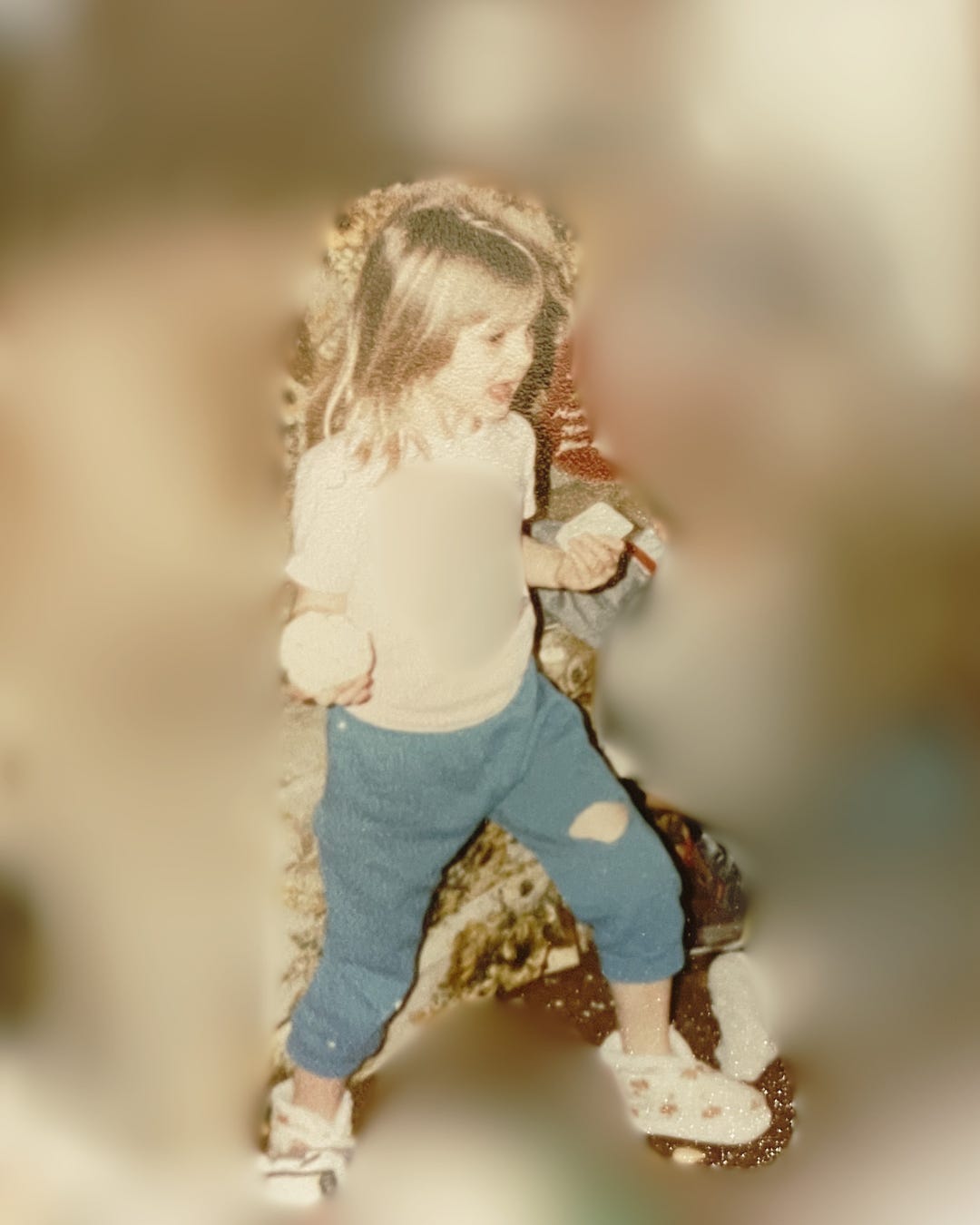
Note the stance. The arms. The facial expression. In most martial arts traditions, that is a classic fighting stance. In yoga, it is the first of the Warrior poses: Virabhadrasana.
A few weeks ago, a well known friend and mentor was doing some name play, something he is famous for in many yoga circles as an expression of love and comradery. He stumbled on the name V…bhadra, blending my preferred name with the Sanskrit warrior and it resonated deeply.
The Story of Virabhadra
According to Hindu mythology, Virabhadra is an incarnation of Shiva that was born out of righteous anger, grief, and a need for protection. Sati, one of Shiva’s consorts (or one incarnation of Shiva’s consort - depending on who’s telling the story), was the youngest daughter of Daksha. Daksha was not a fan of Shiva and when Sati was ready to marry he invited everyone except Shiva, whom Sati had her heart set on. The svayamvara tradition of a bride selecting her husband from a group of assembled suitors began, with Sati tossing a garland into the air and having it received by Shiva, who showed up regardless of not being invited. Daksha had no choice but to accept Shiva as his son-in-law.
One day, Daksha decided to hold a fire sacrifice (yajna) and invited his whole family and all the deities, except Shiva and Sati. Sati insisted on attending anyway despite the insult of not being invited, and Daksha greeted her by humiliating her in front of all the guests and expressing his hatred for Shiva. Sati was so deeply upset by Daksha’s treatment of her that, according to some, she threw herself onto the ceremonial fire. Others say she burst in to flames on her own. Regardless, once Shiva realized what happened, in his rage and grief, he ripped a lock of matted hair from his head and threw it on the ground, where it came to life as a snake that dug into the earth and rose out of the ground where Sati’s ashes lie. Upon rising out of the ground, Virabhadra attacked all of the guests and beheaded Daksha.
Beyond the mythological elements of this story, it is worth noting that the word sati also refers to the ancient Hindu tradition of expecting married women to throw themselves on the funeral pyre when their husbands die. This tradition is allegedly out of practice in modern India, however, it speaks to the history of oppression against women and the need for protection as well as the right to question social conventions.
Interested in learning more about Shiva? Check out my Corpse Pose Yoga Meditation video workshop and Corpse Pose Yoga candle:
Trans Visibility as a Nonbinary Person
One of the aspects of Hinduism that I adore is how all of the deities are known for changing shape and appearance through multiple incarnations. For example, Shiva is also known as Nataraja (the Dancer), Hanuman (the Monkey), and Ardhanarishvara (Half God, Half Goddess). The last one I’m particularly drawn to, because it points to the concept of nonbinary or third gender identity as an ancient idea, not something new or radical.
I don’t like to spend a lot of time talking about being trans for a few reasons. First of all, I have other things to do besides educating people about trans identities. Second, I don’t speak for all trans people. My journey, experience, and goals are unique to me. However, when you live in a culture where people would rather make assumptions instead of asking, or people aren’t willing to examine and be conscious of their assumptions, sometimes clarity comes by defining boundaries.
As a nonbinary trans person, I have been on HRT for a year and a half after starting to socially transition five years ago (using non-binary pronouns, shaving my head, wearing clothes that I feel most comfortable in, etc.).
To be clear:
Gender is a social construct, a set of beliefs that certain people should dress and behave a certain way based on biological markers that have nothing to do with wearing pants versus wearing a dress. Gender is a spectrum, not a binary system.
Gender identity has nothing to do with sexual orientation. Someone assigned female at birth can be trans-masculine or trans-nonbinary and be sexually attracted to men, or women, or both.
Sexual orientation does not define relationship orientation. Monogamy does not work for everyone. Some people are able to maintain healthy intimate relationships with multiple people. Some people actually show up as the healthiest versions of themselves when they have multiple healthy intimate relationships. Do not mistake non-conformity to social conventions for confusion.
I am not confused about my identity or my orientation. I am a person. I am pansexual. I am a relationship anarchist, by orientation…and always have been (it’s not a phase, I promise). My gender transition goals have never been to pass as a man or as a woman. However, historically men have been the only people accepted as people. When I talk about being grateful to have the experience of male privilege at this point in my transition, I’m talking about being treated like a person. For example, being able to wear whatever I want and walk down the street without getting catcalled, or being able to go to a bar and not be harassed, talked down to, or talked over. Wanting to be treated like a person does not make me a man-hating lesbian. In fact, in my own life there are several “old-straight-white-men” that have stepped up and shown up in amazingly supportive ways. Women who have yet to acknowledge and heal their “angry-mommy/queen-bee” narcissism are primarily who I question my safety around.
I’m not obligated to follow the same steps that any trans person before me has followed. Whether I ever legally change my name or have any surgeries does not make me any less trans. My goal has always been gender non-conformity. As such, I am always visibly trans (not just on Transgender Day of Visibility) and my existence serves as defiant activism to a government that oppresses anyone who doesn’t conform to certain social conventions. I have no plans for any surgeries at this time. I also feel no need to legally change my name. Not only would it be a tedious chore that costs money, there are plenty of people of who go by a name different than their legal name, for legitimate reasons. While I don’t use my legal name regularly, it actually gives me a good giggle when I get carded by someone who sees my facial hair and then sees my legal name and does a double take.
I am not transitioning from one type of person to another. I am not “becoming someone else.” I am unbecoming everything that society has told me I have to be.
Dead Names, Pronouns, and Gender Dysphoria
(Or, How to be a Better Trans Ally)
Ask instead of assuming. Ask instead of assuming. Ask instead of assuming.
The name that my parents gave me is a good name. It has served me well for most of my life, though I have had variations of nicknames over the years. I don’t hate it. Does it represent the most accurate version of who I am to date? No. Do I want people to call me by that name? No. Do I currently have business cards and email addresses with that name still? Yes. I am not obligated by anyone to never use my legal name just because I’m trans. Some trans people are very sensitive about their name, and they have every right to be, especially if it causes them pain. Some trans people are not opposed to using their legal name…it doesn’t make them any less trans.
Showing up imperfectly is still better than not showing up at all.
My pronouns are they/them. Not she/her. Not he/him. And, again, to be fair it does give me a giggle when I get called “sir” over the phone at this point. Over the last several months I’ve had some interactions with cis-men who are from parts of the world where soft masculinity is celebrated more than the harsh, toxic masculinity of Western culture, and in their eagerness to validate the masculinity they saw in me they rushed to use as much male-gendered language in our interaction as possible. It was obvious that these individuals were coming from a place of affirmation and support, and these were also passing interactions. I will not likely encounter these individuals again or at least not on a regular basis. It’s perfectly human to make mistakes. Culturally, we don’t always ask others’ their pronouns. It’s okay to ask. It’s okay if you forget to ask and get it wrong, then correct yourself. What’s not okay is not making the effort at all. To assume someone’s pronouns without ever asking, especially when interacting with someone over time is not okay. It’s one thing to get your date’s pronouns wrong on the first date…but after dating someone for a few months, there’s no excuse for not knowing their pronouns.
Consideration is key
A female friend made the suggestion a few months ago that we get our nipples pierced for my birthday. While I’m not opposed to body modifications, I have no real desire to get anymore piercings than I already have unless it’s under the right circumstances. Also, while I have no current desire to surgically remove my breasts that doesn’t mean that I haven’t struggled with gender dysphoria in the past, particularly regarding my chest. It also doesn’t mean that I’m comfortable drawing attention to that area of my body. Obviously, it never crossed my friend’s mind that the suggestion of such an activity could trigger gender dysphoria…if she even understands what gender dysphoria is or the connection between gender dysphoria and suicidal ideation.
Pause, think, and challenge what you take for granted about anyone in your life who might identify as trans. Taking the time to consider what they might think or how they might feel and asking them directly instead of assuming goes a long way towards earning trust and creating/maintaining psychological safety in the relationship.
There is something powerful about grounding trans visibility in history, spirit, and self-recognition instead of letting other people define it for you.
A name chosen in truth is not a rejection of who you were — it is a clearer claim to who you have always been.